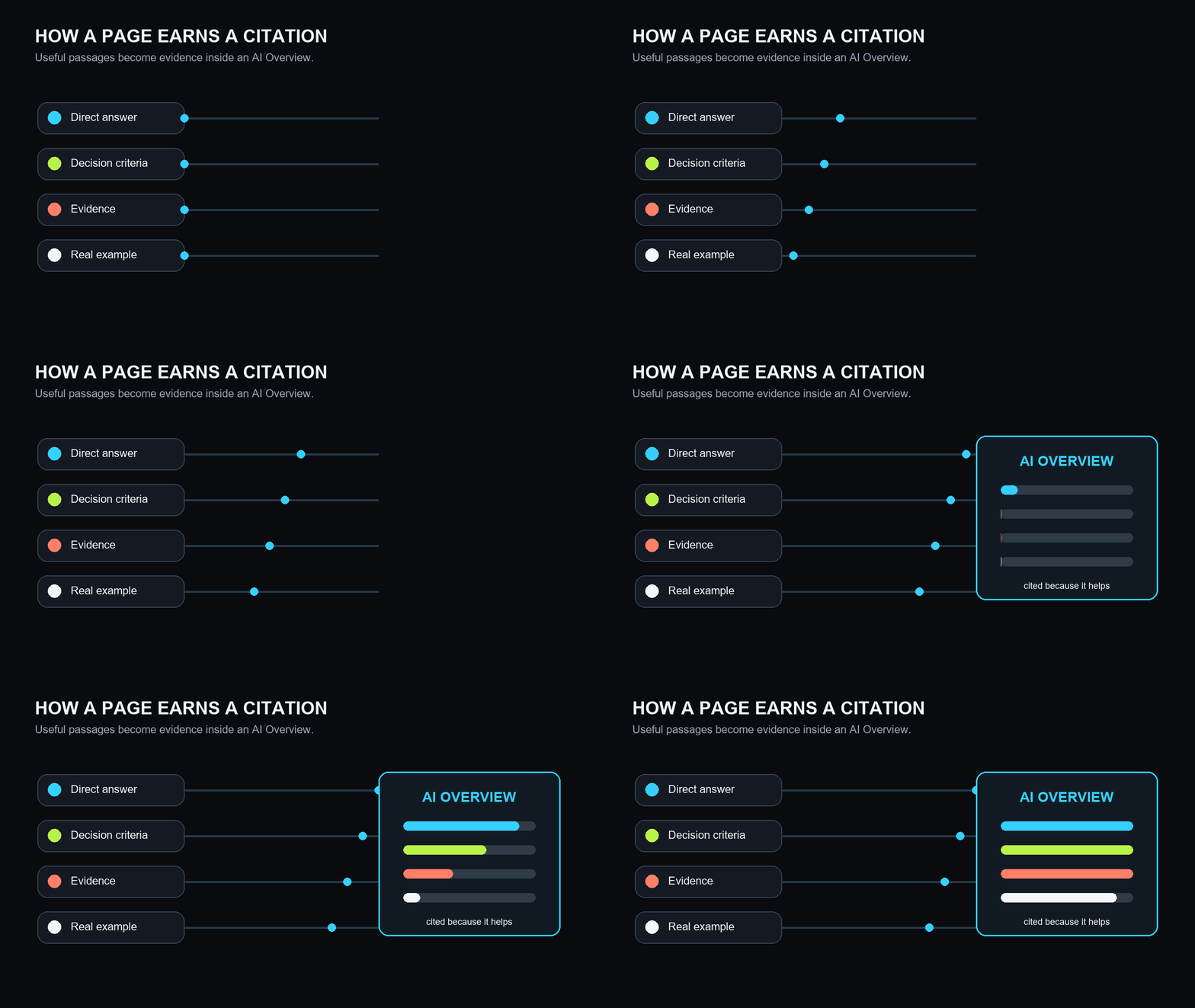
SEO teams once had a clear target: rank near the top and win the click. AI Overviews have added another layer. Google can now answer a question above the traditional results and cite several pages within that answer.
Your page may rank well and still lie below the information a user sees first. This change has created a rush toward generative engine optimization (GEO) frameworks, AI writing formulas, and citation hacks. Yet the practical work remains familiar.
Pages still need to be accessible, useful, well-supported, and closely aligned with the searcher’s question. The opportunity is also wider than the first few organic results. A 2026 study of more than 55,000 searches found that almost 30% of the domains cited in AI Overviews did not appear on the first page for the same query.
Citation selection and traditional rankings clearly overlap, but they do not always produce the same sources. So where should you begin? Start with the pages you already have.
Which pages should you optimize for AI Overviews first?
Your strongest opportunity may already be receiving impressions. Open Google Search Console and look for pages that rank for useful queries but are no longer performing as well as they could. They may sit between positions 4 and 20, attract impressions without many clicks, or answer a topic that now triggers an AI Overview.
Focus on pages with three qualities:
- They already have some search visibility.
- Their topic connects to a product, service, demo, trial, or other business goal.
- You can add information that competing pages have missed. A page with no impressions and little business relevance will usually require more work. A page that already ranks and supports a buying decision has a stronger foundation. That still leaves one problem. Most websites have dozens, sometimes hundreds, of possible pages. You need a way to choose between them.
How do you decide which pages are worth updating?
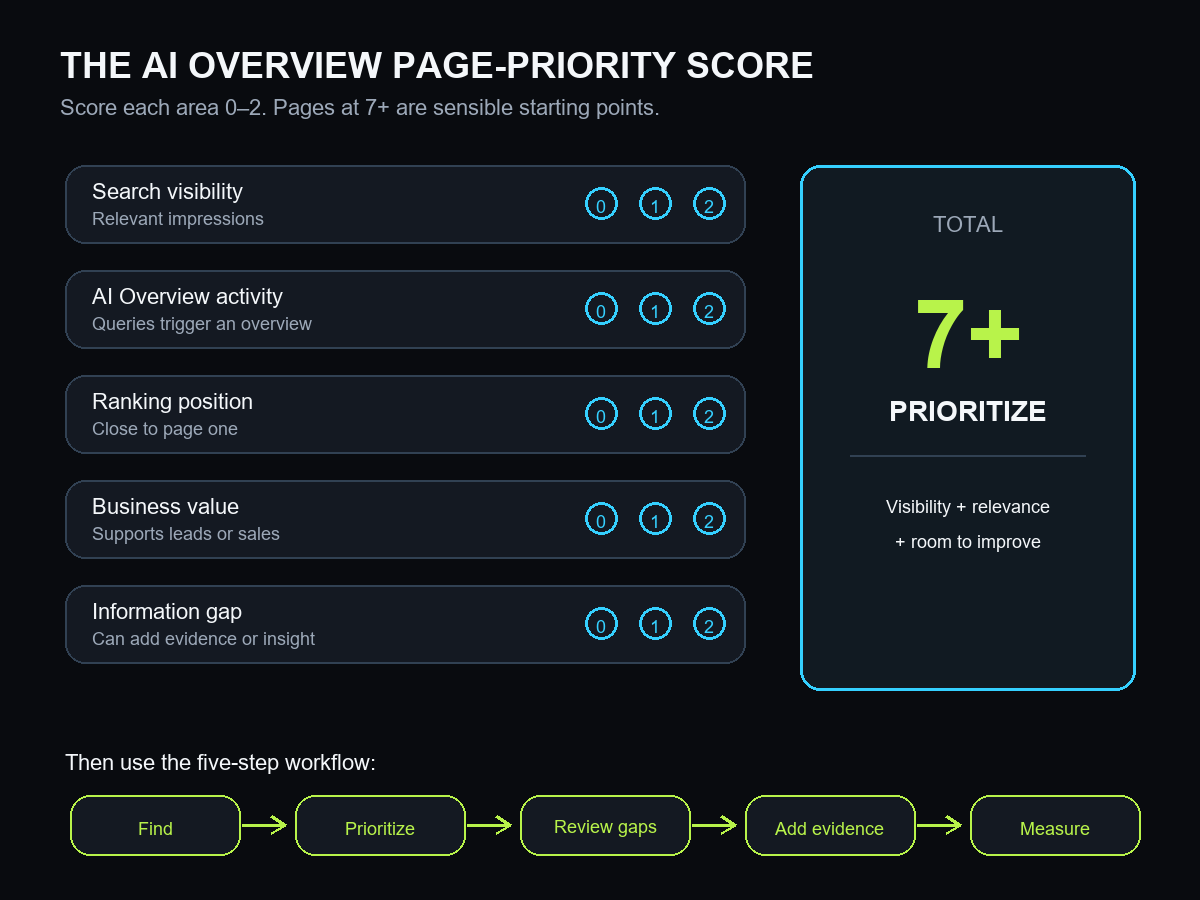
Use a simple page-priority score. We created this framework for editorial planning. It has no role in Google’s ranking system, and it is not an established industry metric.
Its purpose is to help a content team compare opportunities without relying on instinct. Score each page from zero to two across five areas: Area Question Search visibility Does the page already receive relevant impressions? AI Overview activity Do its main queries regularly produce an AI Overview?
Ranking position Is the page already close to the first page or top results? Business value Can the page support leads, trials, demos, or sales? Information gap Can you add expert insight, original evidence, or a clearer decision process?
A page can score a maximum of 10. There is no universal cutoff, but pages scoring seven or more are sensible starting points. A high score does not predict a citation.
It shows that the page has visibility, relevance, and room for a meaningful improvement. Once you have your shortlist, move from pages to queries.
How can you find searches that trigger AI Overviews?
Begin with the queries already attached to each page in Search Console. Group them by the problem behind the search instead of treating every keyword as a separate topic. For example, these searches belong to one buying journey:
- How much does CRM software cost?
- Which CRM features do small teams need?
- When should a startup stop using spreadsheets?
- How long does CRM implementation take? Search each query manually and note whether an AI Overview appears. Then look at the answer itself. Which questions does it cover? Which sources are cited? Where does the explanation become vague? Does it offer real criteria, examples, or limitations? A study based on 11,500 real-user queries found that AI Overviews appeared for 51.5% of the sample. The study also found that small changes in wording could alter whether an overview appeared and which sources it used. Check important queries more than once. Record the wording, date, cited pages, and gaps you notice. A small tracking sheet is enough. The gaps will tell you what the page needs next.
What should you change on the page?
Read the page as someone trying to make a decision. Does it answer the main question early? Does it explain how to choose?
Can the reader apply the advice without opening five other tabs? Many articles cover the subject without helping the reader act. They define a term, list common benefits, and repeat the same recommendations found elsewhere.
A stronger page usually includes four elements: 1. A direct answer near the beginning 2. Clear criteria for making a decision 3.
Evidence supporting important claims 4. Examples showing how the advice works Consider an article about choosing project management software. A basic version lists features such as task management, reporting, and collaboration.
A useful version goes further. It explains which features suit a five-person team, what changes at 100 employees, which integrations affect implementation, and where teams commonly overspend. That depth creates natural follow-up questions.
It also gives the page several useful passages that could support different parts of an AI Overview. The next step is adding insight that cannot be gathered from competing articles alone.
How can expert input improve the article?
Talk to someone who has done the work. A generic quote from a senior employee will add little. Ask questions that reveal what happens in real projects:
- Which mistake appears most often?
- When does the usual recommendation fail?
- What causes delays?
- Which metric do buyers misunderstand?
- What would make you reject a tool or approach?
- What changed after a recent implementation? Use the answers throughout the article. Turn them into examples, warnings, comparisons, and decision rules. An implementation specialist may explain why the cheapest software becomes expensive once migration and training are included. A warehouse leader may show how inventory accuracy affects automation projects. A content director may explain why traffic growth fails to produce qualified leads. These details make the article harder to copy. They also support the first-hand experience and depth encouraged in current Search guidance. Expertise gives the page a point of view. Evidence supports that point of view.
What evidence makes a page more useful?
Every important factual claim should lead to a source the reader can verify. Use original research papers, government datasets, company filings, technical documentation, or official announcements whenever they are available. Place the link close to the claim instead of collecting sources at the bottom without context.
Add enough detail for the reader to judge the number:
- When was the research conducted?
- How large was the sample?
- Which market did it cover?
- Does the finding apply to your audience?
- Were there any clear limitations? You can also create evidence. Internal benchmarks, anonymized customer data, expert surveys, original calculations, screenshots, and before-and-after results can all strengthen a page. Even a small dataset can be useful when the method is clear. Recent research covering more than 21,000 citations across generative search platforms found that influential pages tended to contain extractable evidence such as numerical facts, comparisons, definitions, and procedural steps. Good evidence helps readers trust the answer. It also gives search systems specific information to retrieve. Before publishing, make sure the page can be retrieved in the first place.
Which technical issues can block AI Overview visibility?
A strong article cannot perform when search systems struggle to access it. Check the same technical foundations you would review for organic search:
- Indexing status
- Canonical tags
- Robots directives
- Internal links
- JavaScript rendering
- Duplicate URLs
- Mobile usability
- Important information hidden inside images A page must be indexed and eligible to appear with a search snippet before it can appear in generative Search features. AI Overviews and AI Mode may also run several related searches through query fan-out, which allows them to find supporting pages across different parts of a topic. You do not need a special AI Overview schema. Structured data can still support eligible rich results, but it should match the information visible on the page. An llms.txt file also provides no special advantage in Google Search. Once the technical checks are complete, the update becomes an experiment.
How can you measure whether the changes worked?
Do not judge the page a few days after publishing. Search visibility can move for many reasons, so compare performance across a useful period. 4-8 weeks is a reasonable review window for most established pages, though competitive topics may take longer.
Track three levels of performance: Visibility
- AI Overview impressions
- Recurring citations
- Organic impressions
- Changes in ranking queries Engagement
- Organic clicks
- Click-through rate
- Engaged sessions
- Return visits Business results
- Demo requests
- Trial registrations
- Newsletter sign-ups
- Qualified leads
- Assisted conversions Google introduced a dedicated generative AI performance report in Search Console in June 2026. It includes impressions from AI Overviews and AI Mode, with breakdowns by page, device, country, and date. The report is still rolling out, so it may not appear in every property. For priority searches, keep a small manual tracker as well. Check the same queries every few weeks and record which sources appear. A citation is useful, but it is only one signal. The larger goal is stronger visibility that supports a valuable reader action.
How can you put the process into practice?
The full workflow can be kept to five steps: 1. Find existing pages with search visibility and business value. 2.
A citation is useful, but it is only one signal. The larger goal is stronger visibility that supports a valuable reader action.
Prioritize them using the page-priority score. 3. Review the queries, AI Overviews, cited sources, and missing information.
4. Add clearer answers, expert experience, examples, and verifiable evidence. 5.
Measure visibility, engagement, and business results. This approach does not require a separate publishing engine for GEO. It requires better choices about which pages deserve attention and what information should be added.
AI Overviews pull together answers from across the web. The pages most likely to contribute are the ones that explain a question clearly, support their claims, and help the reader make a decision. That is where the real opportunity lies.