Google’s latest guidance cuts through two years of GEO and AEO noise. Here is what deserves investment, what can be deprioritized, and how to build pages worth citing.
For the past two years, AI search has produced a growing list of new acronyms, frameworks, and supposed ranking tactics. Generative Engine Optimization became GEO.
Answer Engine Optimization became AEO. Agencies began selling AI visibility audits, citation strategies, and new technical files designed for large language models.
Much of that advice was developed before marketers had clear guidance from the platform shaping the largest share of search activity. On May 15, 2026, Google published a detailed guide to improving visibility in generative search features such as AI Overviews and AI Mode.
The document addresses content quality, technical SEO, images, ecommerce data, measurement, and several popular tactics that websites can safely ignore. The guidance arrived as these features moved well beyond the experimental stage.
AI Overviews now has more than 2.5 billion monthly active users, while AI Mode has crossed one billion monthly users. Queries in AI Mode have more than doubled every quarter since its launch.
At the same time, organic search is becoming less predictable. A December 2025 analysis of 300,000 keywords found that AI Overviews were associated with a 58% lower average click-through rate for the top-ranking result.
The dataset compared 150,000 keywords with AI Overviews against 150,000 informational keywords without them. The challenge for marketers is therefore broader than winning the first organic position.
Content also needs to be useful enough to support an AI-generated answer and persuasive enough to earn a click when the searcher already has a summary in front of them. So, what deserves attention, and which AI search tactics are creating unnecessary work?
The guidance in one view
A quick summary of the practices worth investing in and the AI search tactics that can be deprioritized. Area Worth investing in Safe to deprioritize Content Original research, expert insight, first-hand experience, and complete topic coverage Generic summaries and separate pages for every keyword variation Technical SEO Crawlability, indexing, internal links, correct canonicals, and a strong page experience A separate technical infrastructure created only for AI search Formatting Clear sections, useful headings, readable paragraphs, and relevant visuals Breaking every article into tiny “AI-friendly” chunks AI-assisted writing Research support, structure, editing, and content maintenance with human review Publishing large volumes of lightly reviewed pages Structured data Valid markup for established search features and accurate commercial information Invented “AI schema” or excessive markup added only for AI Overviews Brand authority Genuine expertise, customer evidence, and authentic third-party discussion Purchased mentions designed to influence AI citations Measurement AI impressions, qualified traffic, conversions, and branded demand Treating citation counts or rankings as the only success metric The rest of the article explains why these priorities are taking shape and how marketing teams can apply them.
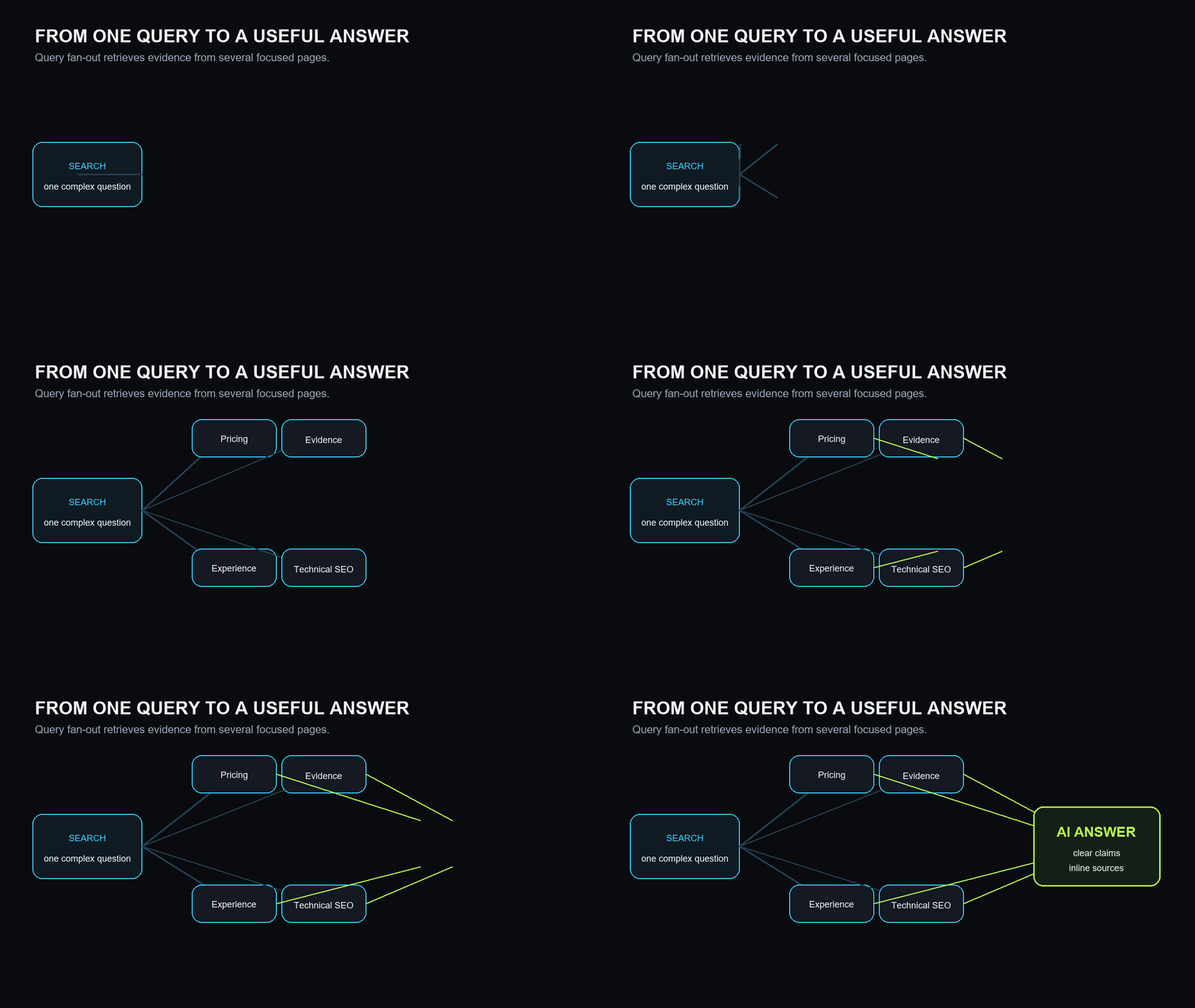
How AI Search finds and combines information
Traditional search usually begins with a query and a ranked set of results. AI search can take a wider route.
A page still needs to enter the Search index through the familiar process of discovery, crawling, and indexing. Once that foundation is in place, generative search can retrieve information from several pages and combine it into a single response.
Two processes are behind much of this experience. The first is retrieval-augmented generation (RAG).
It retrieves relevant and current pages from the Search index, reviews information from those pages, and uses the findings to support the generated answer. The links displayed with the response point users towards the pages that contributed useful information.
AI-generated responses no longer present sources as a simple list at the bottom. Instead, citations appear directly beside the statements they support, making it easier for users to verify individual claims without leaving the response.
This changes how publishers should think about content. Instead of hoping readers scroll to a reference list, every statistic, quote, or original insight now has a greater chance of being surfaced exactly where it is used.
The second is query fan-out. A broad question can trigger several related searches behind the scenes.
Imagine a founder searching: Which CRM is suitable for a 50-person SaaS company with a small sales team? That single question may lead to related searches around implementation time, integrations, pricing, reporting, sales automation, data migration, and customer support.
Different pages may provide useful information for different parts of the final response. This process changes how marketers should think about topic coverage.
A page can become relevant because one well-developed section answers a supporting question, even when the article does not use the exact wording entered by the searcher. The opportunity is to build content around real decisions instead of isolated keywords.
Publishing ten similar pages for ten slightly different phrases gives the reader very little additional value and can leave the website with a fragmented content library. With that foundation in place, the practical recommendations become much easier to understand.
How AI Search is changing the Search experience
Google hasn't only changed how search retrieves information. It has also redesigned how people consume it.
AI responses are becoming richer, more interactive, and better connected to external sources, giving users more ways to verify information and continue their research without returning to a traditional list of links. Several interface changes introduced over the past year illustrate that shift.
A faster model behind AI Mode AI Mode now runs on Gemini 3.5 Flash by default. The model is designed for faster reasoning and more complex, multi-step tasks, allowing Search to interpret detailed questions, gather information from several sources, and respond with less delay.
The upgrade also supports the broader move toward more agentic search experiences. Search is becoming more agentic New AI Search capabilities can handle increasingly complex, multi-step questions by running several searches, reviewing different sources, and combining the findings into one response.
This moves Search closer to an active research assistant rather than a tool that simply returns a list of pages. Inline source links Instead of collecting references at the bottom of an AI response, citations now appear directly beside the claims they support.
Readers can immediately verify statistics, product information, or recommendations without searching through a separate list of sources. Hover previews On a desktop, hovering over a citation reveals the publication name and page title before a click.
Users can judge credibility instantly, making recognizable brands and descriptive page titles even more valuable. Expert Advice Google has started surfacing first-hand opinions from forums, review platforms, creator communities, and social media inside dedicated Expert Advice sections.
Rather than summarizing everything itself, AI Search increasingly highlights people with practical experience. Explore More Many AI responses now conclude with follow-up questions and related topics that encourage users to continue researching instead of ending the search journey after one answer.
Personalized citations For users who subscribe to certain publications, those sources may receive additional visual prominence, increasing the likelihood of engagement with trusted publishers. Google's AI search experience is still evolving, and changes aren't limited to the interface.
Core ranking systems continue to reshape which types of websites receive visibility. One notable update significantly increased the prominence of community-driven platforms such as Reddit, while many YouTube videos and traditional directory sites experienced reduced visibility for affected queries.
The broader pattern highlights how search is rewarding content that reflects genuine expertise, discussion, and first-hand experience rather than pages built primarily to aggregate information.
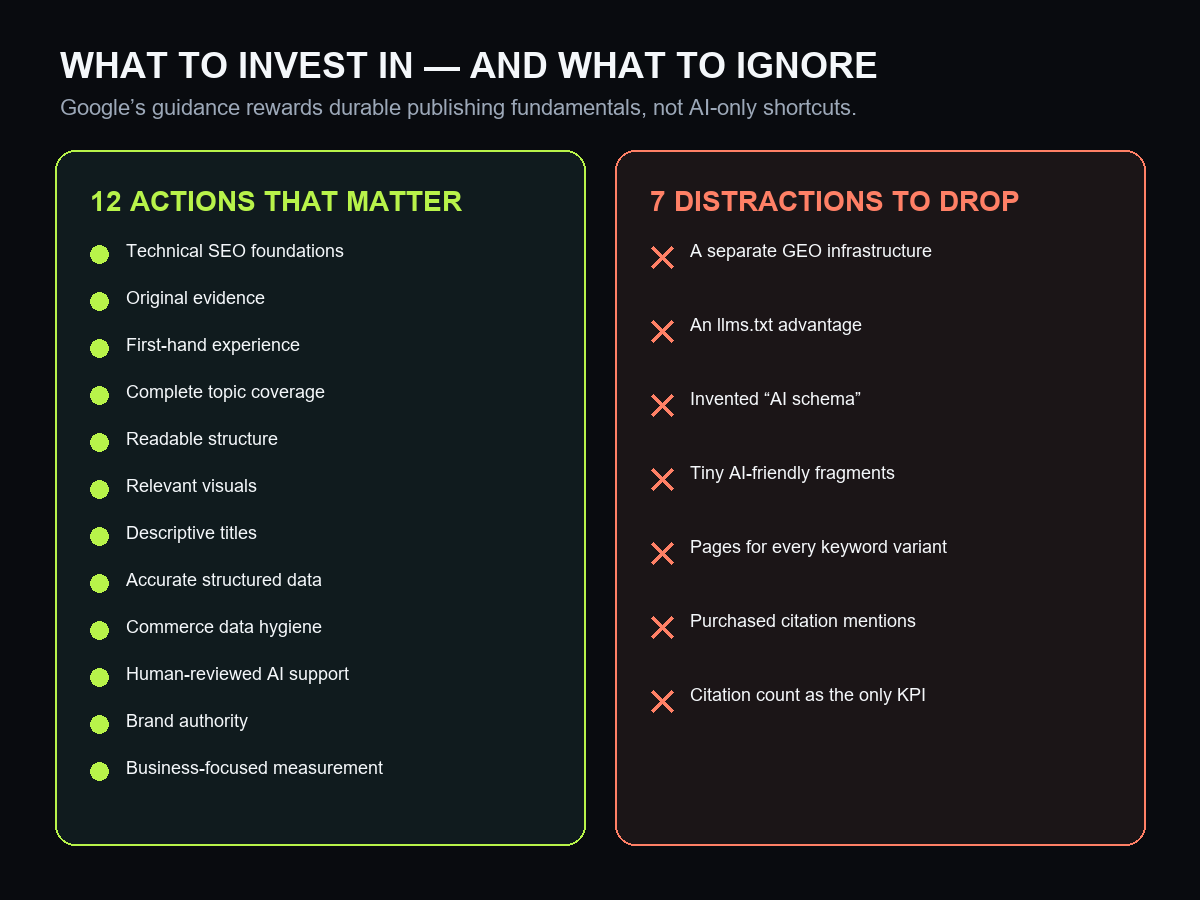
12 practices that can improve AI search visibility
A practical breakdown of the content, technical, and measurement improvements that increase a page’s chances of being discovered and referenced.
1. Strengthen the SEO foundations you already have
AI-powered results still depend on the same infrastructure used to discover and evaluate pages across Search. Technical SEO, internal linking, content relevance, and crawlability remain part of the route into AI Overviews and AI Mode.
Before building a separate AI search program, review whether important pages can already be found and processed correctly. A practical technical review should cover whether:
- Important URLs are indexable
- Canonical tags point to the preferred page
- Internal links connect related articles and commercial pages
- JavaScript prevents essential content from loading
- Images and videos can be accessed
- The page is eligible to appear with a search snippet
- Duplicate or outdated URLs are consuming crawl resources These checks rarely make headlines, but they often determine whether a page is eligible to appear at all. Technical clarity also helps teams diagnose performance. When a well-researched page fails to appear, the team can separate access and indexing problems from issues related to content quality or competition.
2. Publish information that competitors cannot easily reproduce
The strongest theme in the new guidance is the value of non-commodity content. Commodity content is interchangeable.
It may be accurate and well written, yet it adds little beyond what a searcher can already find across dozens of websites. Generic definitions, surface-level checklists, and articles assembled from the current top-ranking results usually fall into this category.
Non-commodity content introduces information with a clear origin. It may come from internal research, customer interviews, product testing, expert analysis, implementation experience, or a strong point of view developed through years of work.
Consider two articles about improving a SaaS pricing page. The first collects seven common conversion tips: simplify the layout, add social proof, clarify the plans, and test the call to action.
The advice is familiar and easy to reproduce. The second article explains how a company redesigned its pricing structure, which customer objections shaped the new page, why two experiments failed, and what happened to trial conversion after the change.
That article contributes evidence that did not exist before the company published it. Originality does not always require a large research budget.
A content team can create distinctive material through:
- Interviews with customers or internal specialists
- Examples from completed projects
- Screenshots of real workflows
- An analysis of public company data
- A comparison based on hands-on testing
- Lessons from a failed launch or implementation
- Benchmarks drawn from anonymized internal data The aim is to give the page a reason to exist beyond targeting a keyword.
3. Put experience inside the article
Author biographies, credentials, and expert reviewers can support trust. The article still needs to show where the experience influenced the analysis.
A warehouse operations guide written by someone who has worked inside distribution environments should contain details about labor constraints, replenishment delays, slotting decisions, and implementation trade-offs. A software comparison should reflect actual product use.
A marketing teardown should explain the choices behind a company’s growth system rather than restating its website. Experience often appears through small details:
- The assumptions that shaped a decision
- The constraint that delayed implementation
- The feature that performed differently in practice
- The customer objection that changed the strategy
- The metric that looked positive but hid a deeper problem
- The compromise the team accepted to keep the project moving These details make an article more useful because they prepare the reader for real decisions. They also separate expert-led content from summaries that can be produced without first-hand knowledge. This broader shift is also visible across search results. Community discussions, product reviews, and expert conversations have become more prominent because they often contain practical insights that are difficult to reproduce through generic content. Rather than competing with those sources, publishers should learn from what makes them valuable: first-hand knowledge, transparent opinions, and evidence from real-world experience.
4. Cover the reader’s full problem
Query fan-out encourages broader thinking about search intent. One question can lead to several related searches, so a page has more opportunities to become useful when it covers the complete decision.
Suppose the primary topic is choosing CRM software for a growing company. The reader may begin with a comparison, but the decision quickly expands into implementation effort, pricing, integrations, data migration, reporting, and adoption.
A strong guide could therefore move through the decision in a natural sequence: 1. Identify the operational problem.
2. Define the essential features.
3. Review integrations and data requirements.
4. Estimate implementation time and internal effort.
5. Compare pricing structures.
6. Examine common risks.
7. Explain how success should be measured.
Each section supports the same reader and the same decision. The article remains focused even though it covers several related searches.
By comparison, a cluster of thin pages often repeats the same introduction, examples, and product claims. Readers move between pages without gaining a coherent view, while the site creates unnecessary overlap.
Comprehensive does not mean adding every fact available on the subject. It means answering the questions that naturally arise before the reader can make a decision.
5. Build an article people can follow
Readable content needs more than short sentences. It needs rhythm, hierarchy, and connected ideas.
Very long paragraphs can make a page difficult to scan. A page made entirely from one-sentence paragraphs creates a different problem: every thought appears to carry the same weight, and the reader loses the relationship between ideas.
A balanced article usually combines:
- Full paragraphs for explanation
- Bullets for grouped examples or checks
- Tables for direct comparisons
- Short answer blocks where the reader needs a quick conclusion
- Visuals where text would make the explanation unnecessarily complex Headings should help readers understand where the discussion is going. They should describe the subject of the section rather than force every idea into a question. Transitions also deserve attention. A section about original content can lead naturally into first-hand experience because experience is one source of originality. A section about complete topic coverage can then lead into structure because deeper content needs a clear route through it. Every section should naturally lead to the next, so the article reads like one continuous argument rather than 12 disconnected tips.
6. Use images and videos to explain
AI search can surface relevant images and videos alongside web links, giving publishers additional ways to appear. The opportunity is strongest when the visual carries information.
Decorative stock photography may improve the appearance of a page, though it rarely helps the reader understand the subject. Useful visuals include:
- A comparison table showing meaningful differences
- A process diagram explaining how a system works
- A product screenshot annotated with important details
- A chart built from original or properly sourced data
- A before-and-after example
- A video demonstrating a complex workflow
- A decision tree that guides the reader towards an option A technical article about website migration could include a redirect map. A warehouse article could show how inventory travels through a facility. A software comparison could display how the same task is completed in each product. Captions and surrounding text should explain the relevance of the visual. Descriptive filenames and accurate alt text also provide useful context, while keyword-stuffed alt text creates a poorer experience. The simplest editorial test is to remove the image temporarily. When the reader loses an explanation, example, or piece of evidence, the visual is doing useful work.
7. Keep essential pages crawlable and indexable
A page must be indexed and eligible to appear with a search snippet before it can support an AI Overview or AI Mode response. Meeting these conditions creates eligibility; inclusion remains dependent on the retrieval and ranking systems.
Content teams should work with technical teams to review pages that contribute directly to revenue or authority. These may include product pages, comparison pages, service pages, original research, and high-value educational resources.
Pay particular attention to:
- Pages blocked by robots.txt
- Accidental noindex directives
- Canonicals pointing towards outdated URLs
- Important content available only after login
- CDN or firewall rules that block crawlers
- Orphan pages with no internal links
- Snippet controls that limit how content can appear
- JavaScript that fails to render key information Search Console now also includes a setting for inclusion in generative search experiences. Inclusion is the default, while exclusion removes a property’s links and content from supported generative features. Most commercial websites will want to remain included. Publishers with licensing or content-control concerns may choose to assess the setting more carefully.
“The opportunity is to build content around real decisions instead of isolated keywords.”
8. Support interactive experiences with clear text
Modern websites rely on calculators, videos, dashboards, animations, and interactive product tours. These experiences can be useful, especially when the reader needs to explore data or understand a workflow.
Problems arise when the essential explanation exists only inside the interaction. Take a pricing calculator.
A search system may struggle to understand the page when the pricing assumptions, available options, and interpretation of the output are never explained in text. Visitors may face the same difficulty before they begin entering information.
A supporting explanation should cover:
- What the tool calculates
- Which inputs does it use
- How the result should be interpreted
- Who the tool is designed for
- Which assumptions affect the estimate
- Where the calculation has limitations The same approach applies to videos and product demonstrations. A written summary helps readers understand what the visual covers and gives search systems enough context to retrieve the page for relevant questions. Interactive features work best as part of a complete page. They should deepen the explanation rather than carry the entire burden of communicating it.
9. Improve the experience after the click
The growth of AI-generated answers creates a difficult trade-off for publishers. Visibility may increase while clicks decline.
Research shows a lower average click-through rate for the top organic result when an AI Overview appeared. The visitors who do arrive, therefore, deserve a page that quickly confirms they made the right choice.
A useful landing experience includes:
- Fast and reliable loading
- A clear relationship between the search question and the opening
- Navigation that helps readers reach relevant sections
- Limited interruption from pop-ups and advertisements
- A visible next step
- Mobile formatting that preserves tables and visuals
- Current information, rather than an article left untouched for years Content duplication also affects the experience. Five overlapping articles can confuse readers about which page is current and force search systems to choose between several weak candidates. Consolidating related pages often creates a stronger result. The best material can be combined, outdated claims can be removed, and internal links can point towards one authoritative resource.
10. Use generative AI with editorial control
Generative AI can support research, organization, and production. It can also make it easier to publish more content than a team can properly review.
Search policies focus on the value and quality of the finished page. Large-scale production without meaningful additions can fall under scaled content abuse, regardless of whether the pages were produced by a person, an AI system, or a combination of both.
Used carefully, AI can help with:
- Organizing research notes
- Transcribing interviews
- Identifying gaps in an outline
- Creating an initial structure
- Comparing claims across sources
- Updating repeated product information
- Checking consistency across a content library Editorial responsibility remains with the publisher. Statistics need verification. Product claims need current evidence. Quotes need accurate attribution. Examples need context. Recommendations should reflect someone who understands the subject and can recognize when an output sounds plausible but is wrong. Disclosure can also be useful when automation played a substantial role, particularly when explaining the process helps readers understand how the work was produced. The production method should support the quality of the article. It should never become the reason the page exists.
11. Keep product and local business data current
AI-powered search is becoming part of product discovery, local research, and commercial decision-making. Generated responses can include product listings, prices, availability, business details, and local recommendations.
For ecommerce and location-based businesses, content alone cannot carry the entire search strategy. Merchant Center feeds and Business Profiles need regular maintenance so the information appearing across search experiences remains accurate.
Review:
- Prices and promotional offers
- Inventory availability
- Store locations
- Opening hours
- Contact details
- Product images
- Delivery terms
- Return information
- Service areas A useful article may introduce a customer to the brand. Incorrect pricing, availability, or opening hours can end the journey before a purchase or visit takes place. Hence, commercial data should lie inside the search workflow rather than being treated as a separate administrative task.
12. Connect AI visibility to business outcomes
As mentioned above, Search Console has started rolling out a dedicated Generative AI Performance report to a subset of website owners. The report includes impression data for AI Overviews and AI Mode, with breakdowns by page, date, country, and device.
The additional visibility is helpful, though impressions alone cannot show whether AI search contributes to growth. A useful measurement framework should combine three levels: Measurement level Questions to answer Example metrics Visibility Where is the brand appearing?
AI impressions, visible pages, countries, and devices Engagement What happens after discovery? Organic clicks, engaged sessions, returning visitors, and branded searches Commercial impact Does the visibility contribute to growth?
Leads, demos, trials, subscriptions, assisted conversions, and revenue A page may gain many AI impressions and very few direct clicks. Another may receive less visibility but attract visitors who are closer to a purchase.
Both cases need analysis at the website and conversion level. Citation or impression counts cannot explain the quality of demand on their own.
7 tactics marketers can safely ignore
The rapid growth of AI search has created demand for fast answers. That environment naturally attracts tactics that promise a simple route to generated results.
The new documentation is useful because it removes several of those distractions.
1. Rebuilding the entire strategy around GEO or AEO
GEO and AEO can be helpful labels when teams discuss AI visibility, citation monitoring, or the way generated answers represent a brand. They do not require a separate foundation.
AI Overviews and AI Mode continue to use the main Search index, ranking systems, and quality systems. Technical SEO, original content, crawlability, and authority remain central to visibility.
A company can add AI-specific reporting and research to its existing search program. Rebranding the whole discipline does not create an advantage by itself.
2. Creating llms.txt for Google Search
The llms.txt proposal has received significant attention as a possible way to provide AI systems with a cleaner description of website content. Google Search does not use it.
Creating the file will neither improve nor damage visibility in AI Overviews, AI Mode, or traditional Search. Other services may choose to support it, so companies can still maintain one for those systems.
It should remain well below crawlability, indexing, and content quality on the priority list.
3. Publishing separate AI versions of every page
Websites do not need duplicate Markdown files, simplified AI pages, or alternative machine-readable versions of each article to appear in generative search. A standard crawlable page is sufficient.
Duplicate versions increase maintenance work and create another place where claims, links, or product information can become outdated. They can also complicate canonicalization when several versions cover the same material.
One complete, current, and well-structured page is easier to maintain than several versions created for speculative technical reasons.
4. Breaking every article into tiny chunks
There is no fixed requirement to divide content into very small answer blocks. Search systems can understand several topics on a page and retrieve the relevant section.
Page length and section length should follow the subject and the reader’s needs. Some sections may need a direct 50-word explanation.
Others may require examples, evidence, and a table. Forcing every idea into two sentences usually weakens the transitions and makes the article feel fragmented.
Good structure creates clear sections without destroying the relationship between ideas.
5. Rewriting content in a special AI-search voice
AI search does not require robotic phrasing, excessive keyword repetition, or a question heading above every paragraph. Modern search systems can understand synonyms, related concepts, and pages that do not repeat the exact wording of every possible query.
Write in the language your audience uses. Define specialist terms when needed.
Use direct answers where they help the reader, and expand the explanation when the subject requires context. A page should sound like a knowledgeable person explaining the topic clearly.
6. Selecting a universal word count
No ideal word count exists for AI search. A narrow question may be fully answered in 600 words.
A technical guide or research-heavy teardown may need several thousand. The subject, evidence, and decision complexity should determine the length.
Longer articles become weaker when additional words repeat the same idea. Very short articles fail when they leave out the information a reader needs to act.
Length is an editorial decision, not a ranking formula.
7. Buying artificial mentions or adding invented AI schema
Generated results can draw from discussions across blogs, videos, and forums, which has encouraged some brands to pursue mentions created only to influence AI visibility. Manufactured references offer little durable value.
Search systems still rely on quality and spam controls when evaluating the wider web. There is also no special schema.org markup that unlocks AI Overviews or AI Mode.
Structured data should continue to support established search features and remain consistent with the visible page. Authentic reputation develops through useful products, credible research, satisfied customers, and worthwhile coverage.
It cannot be replaced by a markup field or a purchased forum comment.
What remains uncertain
The guidance settles several tactical questions. Source selection, traffic quality, and reporting still contain large gaps.
Why is one page cited and another is ignored
The documentation explains retrieval-augmented generation and query fan-out, but it does not publish a weighting system for individual sources. A page may rank highly in traditional search and still fail to appear in an AI response.
Another may support one part of the answer even when it does not hold a top organic position for the original query. Marketers can improve eligibility through strong technical foundations, original information, and complete topic coverage.
They cannot guarantee a citation for a specific prompt.
Whether better visits can compensate for fewer clicks
Platform messaging has emphasized prominent links, website previews, and new link designs designed to encourage exploration. Independent research continues to show significant pressure on organic click-through rates.
A website could receive fewer visitors while attracting a higher proportion of people with strong intent. That possibility has to be tested through each company’s analytics, lead quality, and conversion data.
Which fan-out searches are running behind a response
Query fan-out explains why detailed topic coverage can help. The actual supporting queries remain hidden.
Content teams can predict common follow-up questions through customer interviews, search data, sales conversations, and product research. They cannot see the precise set of searches generated for every AI response.
The best defence against that uncertainty is a content strategy built around real customer decisions rather than a list of prompt variations.
How quickly will AI Overview coverage change
In an analysis of more than 10 million keywords between January and November 2025. AI Overviews appeared for 6.49% of the tracked queries in January, climbed to 24.61% in July, and fell to 15.69% in November.
Likewise, an analysis of more than 600,000 commercially focused keywords found an average 71% increase in AI Overview appearances across ten industries over six months. Forecasts based on one month, industry, or keyword set will age quickly.
The direction is clear, AI answers are expanding across the search journey, while the exact frequency remains volatile.
Search rankings are changing alongside AI Search
AI Search is developing alongside broader changes to the ranking systems. A March 2026 core update was followed by another core update in May, while a global spam update rolled out in late June.
These updates were not limited to AI Overviews, but they could still change which pages and domains are available for AI systems to retrieve. This makes attribution difficult.
A loss of traffic may come from an AI-generated answer reducing clicks, a ranking update changing organic visibility, or both happening at roughly the same time. Marketers should compare Search Console, analytics, ranking changes, and conversion data before connecting a performance shift to one cause.
Discover also received a dedicated core update in February 2026. The change affected how articles are surfaced in personalized feeds, reinforcing the need for publishers to produce original, relevant reporting rather than treating Discover as another headline-distribution channel.
What should marketers do next?
Start with the pages already connected to revenue, product adoption, or brand authority. Confirm that they are crawlable and indexed.
Review whether each page answers a complete customer problem. Replace generic claims with evidence, expert commentary, and examples from real work.
Consolidate overlapping articles and strengthen the internal links between educational and commercial content. Next, review the wider search experience.
Product feeds, business details, visuals, page speed, and mobile usability all influence what a visitor sees before and after the click. Finally, update the measurement.
Rankings remain useful, though they no longer describe the entire search journey. AI impressions, branded demand, qualified visits, lead quality, and assisted conversions give a more complete view.
The search industry will continue producing new terms and shortcuts. The official guidance offers a more durable direction: make the website technically accessible, give every important page a clear purpose, and publish information that deserves to be retrieved.
AI has changed the shape of the results page. The standard for useful information remains demanding: original evidence, clear reasoning, genuine experience, and a page worth visiting after the summary ends.